
Atlas Global Equity Income – Monthly Manager Commentary
September 2026

During the month we took the opportunity to take some profits, trimming our positions in Diploma and Gaztransport et Technigaz. Both have performed strongly this year. The cash will be reinvested into other areas of the portfolio where we believe business fundamentals and valuations are attractive.
Featured holding – Next
Next stands out as one of the UK’s most successful retailers. Over many years it has carefully positioned its high-street presence while quietly combining this with a profitable and scalable e-commerce platform.
In order to consider what the future might hold for the business, it is important to first look
back at the history of the group and how the company has evolved into today’s high-quality, customer-centric retailer.
Some background and history
Next can trace its roots to a 19th-century tailoring business. Established by Joseph Hepworth in 1864, Leeds-based J. Hepworth & Son grew into a nationwide chain of menswear stores and became a familiar high-street name over the following century. By the early 1980s it remained a solid but traditional menswear retailer.
In 1981 the group acquired the Kendalls chain for £1.75 million. This gave it hundreds of additional locations. The chairman at the time, Terence Conran, recruited George Davies to revitalise the Kendalls stores, but Davies’s vision was more ambitious: rather than simply rebranding the existing chain, he wanted to create an entirely new fashion brand.
Next for Men was launched in August 1984, with dozens of stores quickly following and many former Hepworth shops converted. It was the birth of Next’s modern identity. Mini department stores combining menswear, womenswear, shoes and cafés duly appeared.
In 1986 the parent company changed its name from J. Hepworth & Son to Next plc and moved its headquarters from Leeds to Enderby, near Leicester – closer to the centre of garment manufacturing.
In the same year it also acquired mail-order company Grattan. This became the pivotal Next Directory – a glossy, innovative home-shopping catalogue offering attractive ranges and quick delivery. This built the logistics, warehousing and customer-service infrastructure that would later underpin Next’s online success.
Growth under Davies was explosive. Group profits rose sharply during the mid-1980s. However, by late 1988 the business had over-expanded, resulting in mounting debts and a collapsing share price.
In December that year Davies was ousted in a boardroom coup led by David Jones, who had arrived with the Grattan acquisition. Jones took over as CEO and oversaw a period of consolidation. The company sold Grattan in 1991, closed or rationalised underperforming parts of the business and concentrated on the core Next brand.
In 1993 Next formalised a strategy of “One brand; two ways of shopping”, aligning ranges across stores and the Next Directory. Six years later it launched internet shopping via the Directory website, extending the strategy to “One brand; three ways of shopping.” Next-day delivery for Directory orders placed before 10pm soon became a significant competitive advantage.
Growth-focused management
Next has since continued to evolve, and it is important not to underestimate the impact that current CEO Simon Wolfson has had on the business over the past 25 years – especially with regard to the strategic shift into e-commerce. In particular, Wolfson’s management team has applied two guiding principles:
- “Deliver products and services that we can honestly say create value for customers. Everything must pass the simple test: would you genuinely recommend this product or service to your friends?”
- “Deliver the net margins and returns on capital commensurate with the risks associated with a fast-moving industry. In simple terms: do your best for your customers and follow the money – the rest will take care of itself.”
Wolfson was appointed CEO in 2001, at the age of 33. The son of former chairman David Wolfson, he has led the company since, earning a reputation for rigorous operational focus and disciplined capital allocation.
Under his guidance, Next has strengthened its logistics and fulfilment capabilities, refined stock management and invested heavily in online infrastructure while keeping a profitable store estate. Crucially, online sales have grown to become the dominant channel.
The company has also expanded its own-brand ranges and introduced third-party brands through its LABEL platform. In addition, it has built its Total Platform services business, offering warehousing, fulfilment, technology and customer service to other brands.
International e-commerce has become a major growth engine, operating through Next’s own websites and third-party aggregators across dozens of countries, with particularly strong recent performance in Europe and the Middle East. Meanwhile, the management team has made selective acquisitions and investments – including stakes in Reiss, Joules, Russell & Bromley and FatFace – while continuing to develop wholly owned and licensed labels.
By the mid-2020s Next was regularly reporting group sales above £6 billion and pre-tax profits exceeding £1 billion, with online sales driving much of the growth and stores remaining strategically useful for click-and-collect purchases (and returns).
From a Victorian tailoring firm to a 1980s fashion innovator, from near-collapse to recovery, from reinvention to a modern retail/logistics powerhouse, Next boasts a history that illustrates continuous adaptation grounded in strong execution. The business has evolved from a single UK clothing brand into a multi-brand, omni-channel platform with significant overseas reach – all while retaining the product and operational disciplines that define it.
Avenues for further growth
We believe Next has built one of Europe’s most effective retail operating systems by layering decades of logistics expertise, proprietary technology and customer data onto an evolving e-commerce platform. As well as fuelling growth, this infrastructure drives diversification beyond the UK.
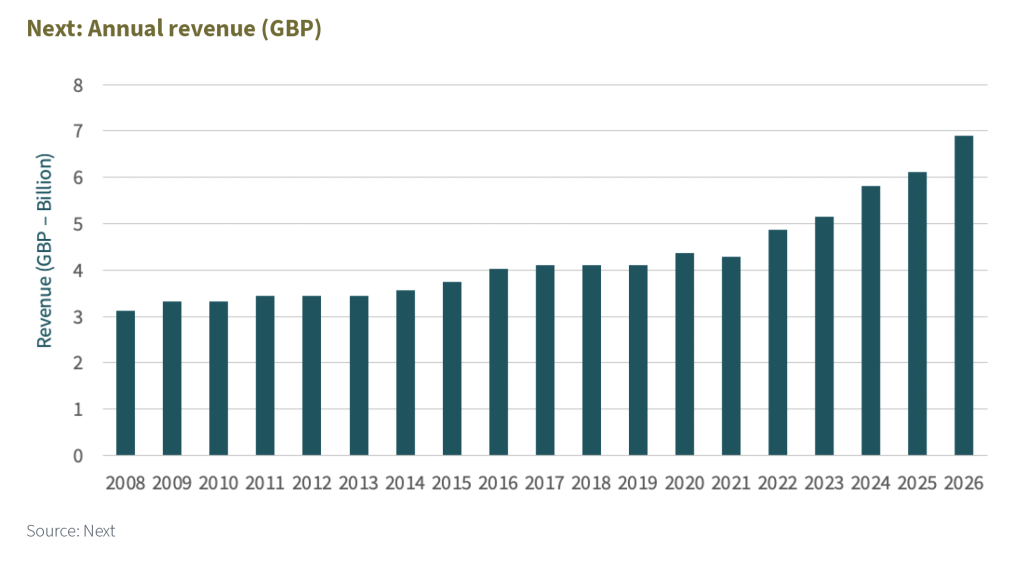
The chart below shows revenue generated from 2008-2026. Notice in particular the level of post-pandemic growth, much of which can be attributed to sales facilitated by ever-increasing online capability.
Let us take a closer look at some of the elements of the business which we believe will continue to drive further growth over the years ahead.
Digital backbone
As we have seen, Next’s online platform did not start with a website. It began with the Next Directory, which was launched in 1988 as a sophisticated home-shopping catalogue.
This required large-scale warehousing, efficient picking and packing, a national delivery network and robust order-management systems. By the late 1990s and the 2000s, when internet shopping accelerated, Next already possessed the physical and operational infrastructure that pure-play online retailers had to build from scratch. The Directory’s systems transitioned relatively smoothly into e-commerce, giving Next an early profitability advantage in online retail.
By the mid-2000s the company began experimenting with third-party brands on its website. This evolved into LABEL, Next’s online aggregation business. Over time it expanded to encompass more than a thousand third-party brands.
Non-Next products now form a large share of UK online sales, broadening the range far beyond what the Next brand alone could offer and increasing customer frequency and basket size.
Core infrastructure
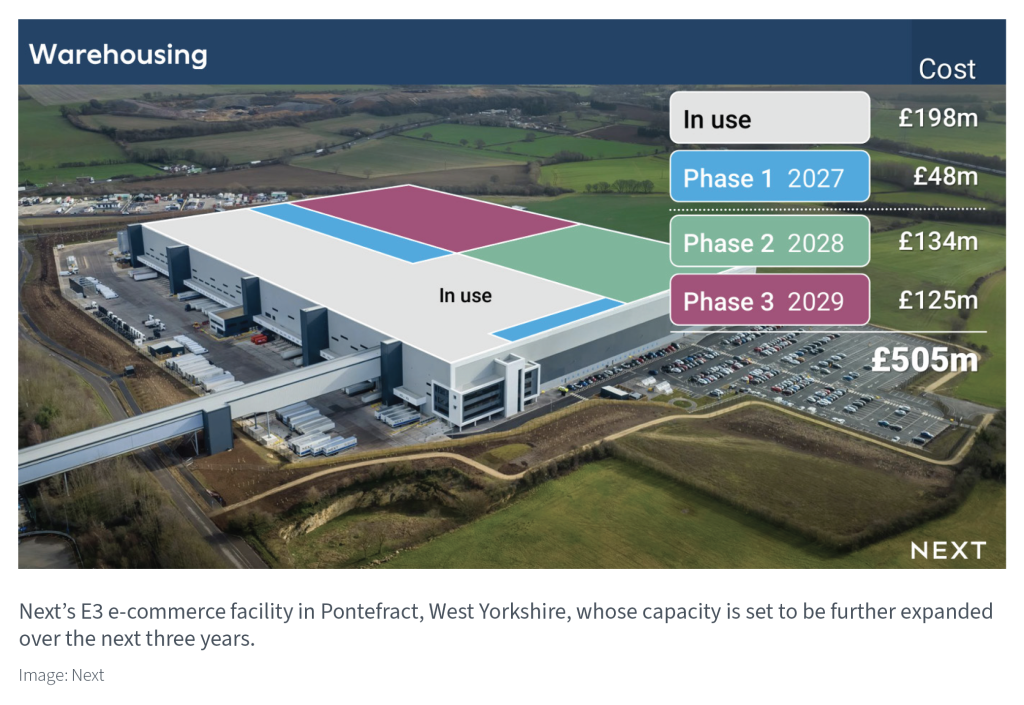
Next operates multiple specialised warehouses, including highly automated facilities for the majority of online volume. Recent investments include the E3 warehouse in Pontefract, West Yorkshire, which has significantly increased automated capacity.
A dense store network functions as a distributed logistics asset. Roughly half of UK online orders are collected in-store, and the majority of returns flow back through stores. This reduces last-mile costs and improves customer convenience.
Delivery networks, depots and international hubs, including a Middle East hub and European arrangements, complete the logistics base. Next has also modernised its proprietary software – warehousing systems, websites, point-of-sale and order management – much of which is written in-house.
Total Platform
In 2020 Next formalised its infrastructure as a commercial product called Total Platform. This is a full-service offering that allows external brands to outsource the capital-intensive and operationally complex parts of online retail.
Clients retain control of design, buying and brand identity. Meanwhile, Next runs websites (often under the brand’s own URL), digital marketing, warehousing, fulfilment, returns, contact centres, payments and customer service. Next typically earns a commission on sales.
Total Platform has attracted brands seeking to avoid heavy investment in logistics and technology. It has also become a vehicle for deeper partnerships, with Next taking equity stakes or forming joint ventures with numerous brands. In many cases the brands migrate their online operations fully onto Next’s systems.
A further evolution, referred to as Total Enterprise Platform, extends the offering deeper into product management, buying systems and back-office functions. This turns Next’s fixed-cost infrastructure into a scalable, multi-customer service that spreads overheads and generates recurring revenue.
International scaling
We have seen how Next’s e-commerce offering centres on a highly efficient, integrated online platform that combines its own brand with a rapidly expanding multi-brand offering, underpinned by superior logistics, customer data and omni-channel capabilities. UK online sales alone reached £2.8 billion in the year to January 2026 (up 10%), while international online sales reached £1.3 billion (up nearly 40%).
Key strengths include fast delivery (next-day for a high proportion of orders), slick click-and-collect and returns via the store network and lockers, a loyal customer base of millions – around 9.6 million UK online customers, plus millions overseas – and the ability to offer credit options.
Critically, LABEL and wholly owned brands/licences (WOBL) now form a large and growing share of online sales. Around 42% of UK online sales are non-Next-branded. This allows broader ranges without full inventory risk while leveraging Next’s warehousing, technology, marketing and customer reach.
In conclusion
In recent years international online sales and non-Next brands have contributed a significant share of growth, reducing the group’s reliance on the UK high street and the pure Next brand. The e-commerce platform is no longer merely a channel for Next’s own products: it is the core product – an operating system for multi-brand, multi-channel fashion and home retail which continues to compound.
We think this will be a key driver of future revenue and profit growth and has the potential to scale significantly.
In a sector marked by high-street casualties, online pure-play struggles and consumer caution, Next has delivered steady sales and profit growth, frequent upgrades to guidance and strong returns for shareholders. Its business model – rooted in product discipline, operational excellence and platform economics – explains both its domestic leadership and its accelerating overseas success.
It is often said that “retail is detail”, and we believe the management team at Next is very much on top of this aspect. Moreover, we believe more is likely to come as the business responds to an ever-changing consumer landscape. With this in mind, in our view, Next has a bright future and is well placed to perform – which should ultimately prove rewarding for patient shareholders.
Disclaimer
As at the end of September 2026, Atlas Global Equity Income holds a long position in Next.
This article is not to be taken as investment advice.
Michael Foster, Fund Manager and Roger Breuer, Analyst – Atlas Global Equity Income
September 2026

………………………
| AUTHORISED AND REGULATED BY THE FINANCIAL CONDUCT AUTHORITY |
| MEMBER OF THE LONDON STOCK EXCHANGE |
| NOT FOR DISTRIBUTION IN THE U.S.A. |
This factsheet has been issued by Fiske plc on the basis of publicly available information, internally developed data and other sources believed to be reliable and accurate. No representations or warranty, expressed or implied, is made nor responsibility of any kind is accepted by Fiske plc, its directors or employees either as to the accuracy or completeness of any information stated in this factsheet. Any opinions expressed (including estimates and forecasts) may be subject to change without notice. This document is not intended as an offer to buy or sell the fund nor as a personal recommendation. Fiske plc, or any of its connected or affiliated companies or their employees, may have a position or holding or other material interest in the fund concerned or in a related investment, or may have provided within the previous twelve months, significant advice or investment services in relation to the investment concerned or a related investment.
Investors must be aware of the risks associated with investment in this fund. Full details of the Atlas Global Equity Income Fund, including risk warnings, are published in the Prospectus and Key Investor Information Document (KIID). Please see www.fiskeplc.com for further information. The fund may not be suitable for all investors and if you are in any doubt whether the fund is suitable for you, advice should be sought from a suitably qualified professional advisor. The value of the fund and the income derived from it can go down as well as up. Investors may not get back their initial investment. Past performance is not necessarily a guide to future performance. Estimates of future performance are based on assumptions that may not be realised. Securities denominated in foreign currencies may see their value fall as a result of exchange rate movements. Any comments contained in this factsheet are intended only for the use of the individual or entity to which it is addressed and may contain information which is confidential and may also be legally privileged. If you have received this document in error, please telephone the Compliance Department on +44 (0)20 7448 4700. Fiske plc FCA Register No: 124279