Atlas Global Equity Income – Monthly Manager Commentary
October 2026

During the month we took the opportunity to take some profits in McKesson, as the shares had rallied strongly over the past few months. We exited our position in Coloplast due to concerns over the performance and integration of Kerecis and increasing competitive pressures. In other areas, we added to our position in Fastenal after the shares fell on what we perceived was a strong trading update.
Featured holding – Lumentum
Lumentum is a US-based optical technology company. Its lasers, optical components and complete systems help transmit data through fibre networks and support industrial applications.
The business’s growing relevance to investors comes from the rapid buildout of AI data centres, which require faster and more power-efficient optical connections.
In this article we explain how Lumentum developed and how its principal laser technologies work. We also provide a brief overview of where some of its key products fit within data centres’ infrastructure.
The first laser
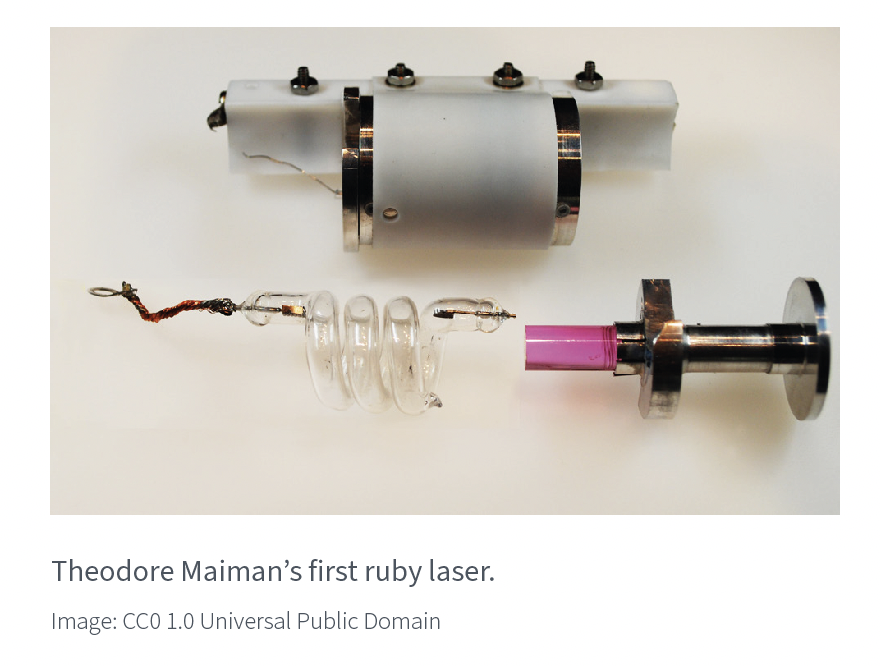
The breakthrough that laid the foundations for the technologies that Lumentum sells today took place more than half a century before the business became an independent company. On May 16 1960, at California’s Hughes Research Laboratories, physicist Theodore Maiman operated the first working laser.
Maiman’s device used a synthetic ruby crystal, excited by a flashlamp, to produce pulses of coherent red light. The achievement turned the laser from scientific theory into a practical technology that would eventually transform manufacturing, medicine, telecommunications and data transmission.
The origins of Lumentum
By the late 1970s, barely 20 years after Maiman’s groundbreaking work, lasers were moving beyond the laboratory and finding a growing range of commercial applications.
Against this backdrop, Uniphase was established in 1979 in a garage in San Jose, California, initially producing lasers for applications including semiconductor manufacturing and scanning. JDS Optics was founded in Ottawa two years later.
The two corporate histories eventually converged in 1999, when Uniphase and JDS merged to form JDS Uniphase. JDS Uniphase briefly became one of the world’s most valuable technology companies, reaching a stock-market value of around $100 billion as demand for fibre-optic networking equipment soared during 2000’s dot-com and telecommunications boom.
The boom eventually gave way to a severe industry downturn, and over the following years JDS Uniphase evolved into a more diversified optical and communications technology group. Its distinct businesses separated into two independent companies in 2015. Its optical communications and commercial laser businesses were spun off to form Lumentum, while the remaining network testing, monitoring and optical security businesses became Viavi Solutions.
Acquisitions have since significantly broadened Lumentum’s technology portfolio. One of the most important came in December 2018 with the acquisition of Oclaro – a move that added capabilities in indium-phosphide lasers, photonic integrated circuits, coherent components and optical modules. In August 2022 Lumentum acquired NeoPhotonics, strengthening its 400G coherent optical technology and engineering capabilities as fibre networks moved towards higher transmission speeds.
Later, in November 2023, Lumentum acquired Cloud Light for approximately $750 million. This was particularly significant, as Cloud Light specialised in high-speed optical transceivers – bringing Lumentum further into the market for complete modules rather than simply supplying the laser components inside them.
Light beats copper
The generative-AI boom began in late 2022, but its impact on Lumentum was delayed. Early investment centred on computing capacity, while Lumentum was simultaneously contending with an inventory correction and weaker telecommunications demand.
The expansion of AI clusters eventually brought the challenge of connecting thousands of increasingly powerful processors quickly and efficiently. As data rates and distances increased, copper cabling became progressively more difficult and power-intensive to use, accelerating the transition towards optical networking using light.
The move towards 800G connections increased the need for optical rather than copper connectivity, particularly over longer distances, consequently boosting demand for Lumentum’s laser products. The impact began to appear in the company’s results during 2025 and accelerated dramatically in 2026.
The chart below, which shows Lumentum’s quarterly revenue since Q1 2022, illustrates this delayed transition.
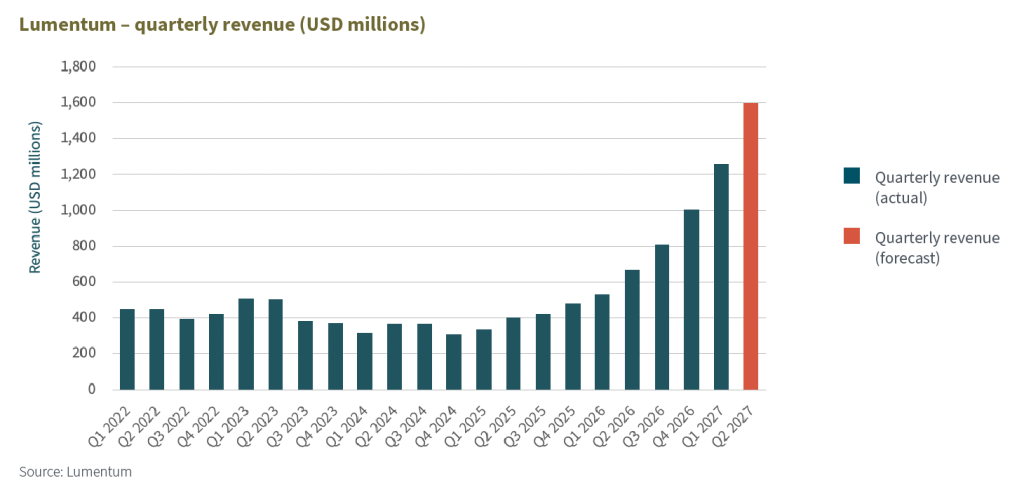
Lumentum’s history has taken the business from the early commercial laser industry to the heart of today’s AI infrastructure boom. It has expanded from industrial lasers into the optical products needed to move huge amounts of data through modern networks. As AI pushes traditional copper connections towards their limits, Lumentum’s long experience of using light to transmit data has become more valuable than ever.
Understanding lasers
To understand Lumentum’s portfolio, it is helpful to become familiar with a few important terms. Be warned: the world of lasers is littered with acronyms!
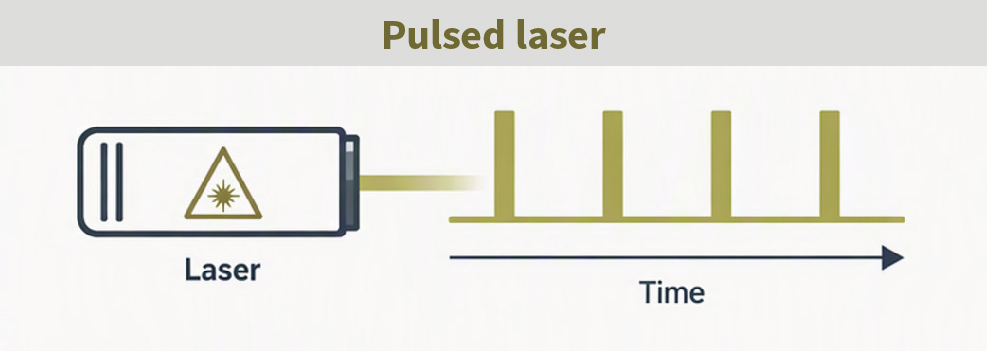
Pulsed laser: A pulsed laser produces light in short, powerful bursts rather than continuously, much like a camera flash. Delivering the energy in pulses can limit heat build-up while still providing high peak power. This makes pulsed lasers particularly useful in industrial applications where short, concentrated bursts of energy are required.
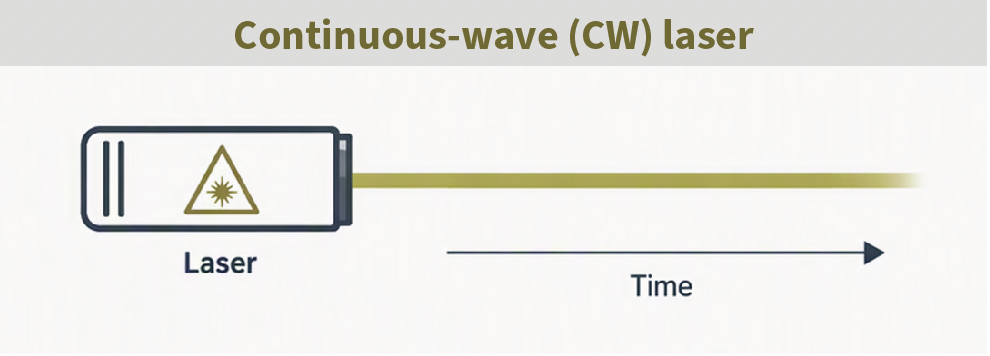
Continuous-wave (CW) laser: Unlike a pulsed laser, a CW laser produces a steady, continuous beam of light. This makes CW lasers particularly useful in data centre communications, where a constant source of light can carry enormous amounts of data once a signal is modulated. CW lasers are becoming increasingly important in technologies such as silicon photonics, where they provide the light while separate components control it to transmit data.
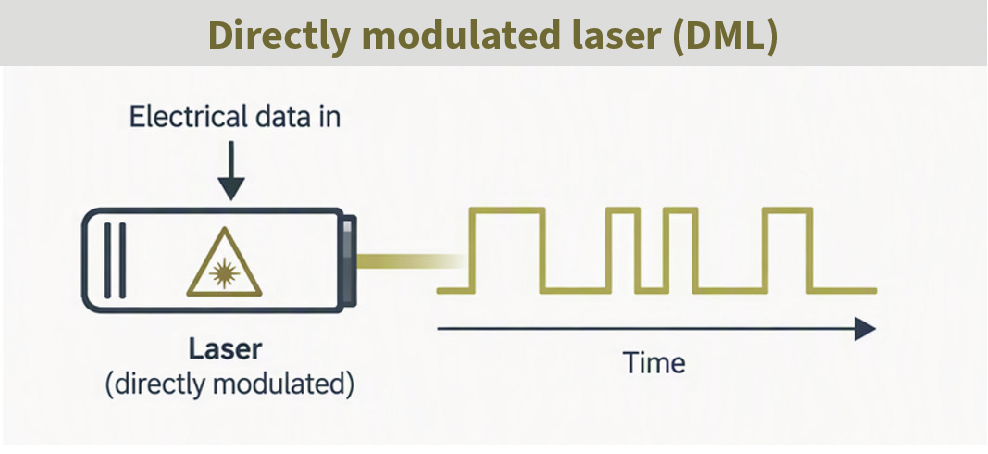
Directly modulated laser (DML): A DML puts data onto the light by rapidly changing the laser itself. In simple terms, the electrical current driving the laser is rapidly switched on and off or between different levels, causing the laser’s light output to change in line with the data being transmitted. This provides a relatively straightforward way of turning electrical data into an optical signal and is widely used in data centre and telecommunications connections. However, DMLs suffer from “chirp”, where modulation causes small wavelength changes that become increasingly disruptive as data rates rise.
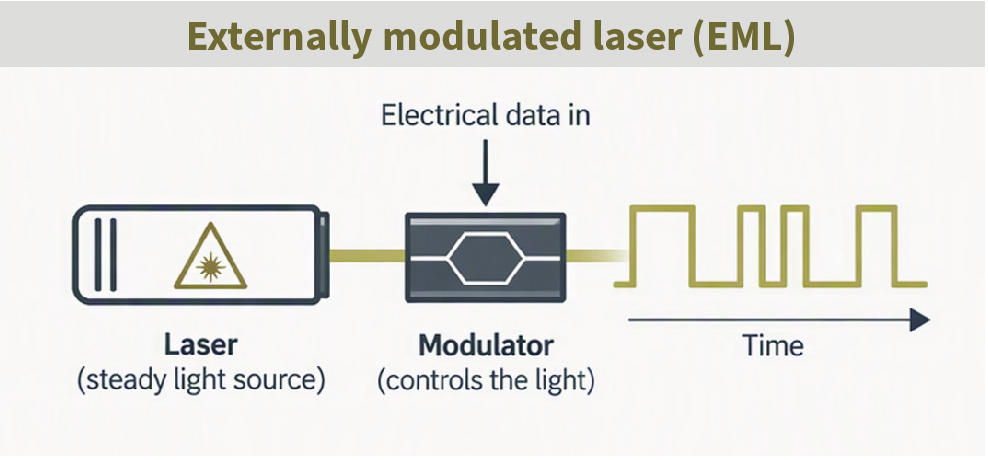
Externally modulated laser (EML): To avoid chirp, EMLs take a different approach. They produce the light, which a separate modulator then controls in a way that encodes the data. In effect, an EML provides a steady source of light while a modulator acts like an extremely fast shutter. This approach is particularly suited to very high-speed optical communications, making EMLs important for the increasingly fast connections required inside AI and cloud data centres.
Lumentum’s segments
Lumentum reports revenue through two segments: Components, which includes products incorporated into customers’ equipment, and Systems, which includes complete, standalone solutions.
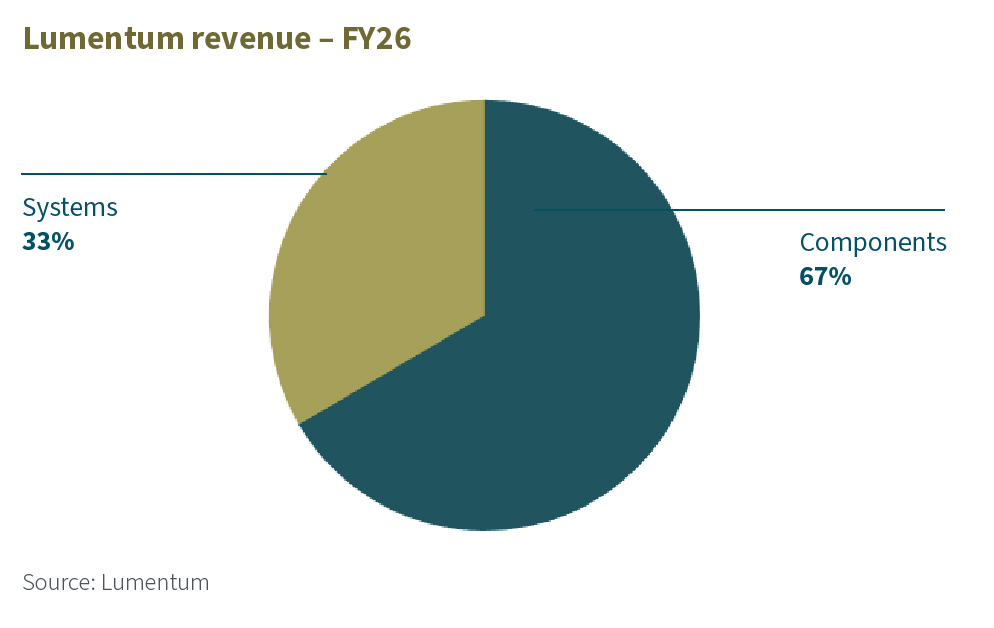
According to the company’s FY26 Form 10-K, the Components segment includes “semiconductor laser chips, laser sub-assemblies, line subsystems and wavelength management systems”.
The company does not explicitly list the products within this segment, but a review of recent quarterly earnings calls helps inform the following table of likely Components products. We have already discussed CW lasers, DMLs and EMLs, but there are other products that are important to Lumentum.
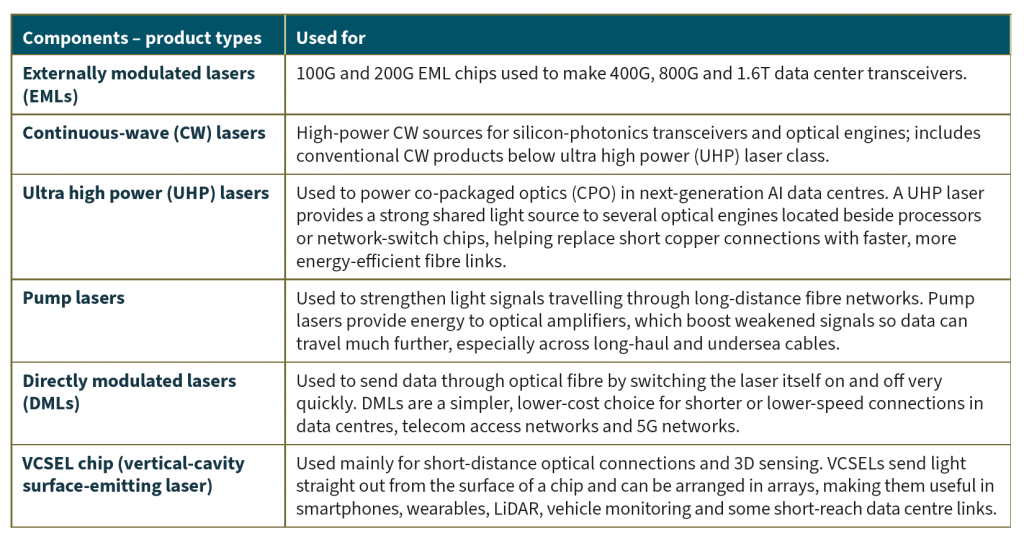
Components: a closer look at EMLs
Alongside Broadcom and Mitsubishi Electric, Lumentum is one of the three dominant global suppliers of externally modulated lasers. The three companies account for approximately 72% of the EML market, according to TrendForce, although publicly available data does not disclose Lumentum’s individual market share.
EMLs have been performing particularly strongly, benefiting from their speed advantage over DMLs in high-speed optical applications. Speaking during an earnings call in August 2026, Lumentum CEO Michael Hurlston commented: “We delivered another record-breaking quarter for EMLs, primarily driven by strong demand for 100G per-lane devices. Momentum for our 200G EMLs is also accelerating rapidly, now accounting for over 25% of total EML revenue.”
“100G” and “200G” refer to the data rate per optical lane. For example, 100G represents 100 gigabits per second per lane.
Importantly, the challenge for Lumentum is not simply generating demand but producing enough EMLs to satisfy it. On the company’s Q2 2026 earnings call, which took place in February 2026, Hurlston said: “To be very clear, all of our EML capacity is already committed under these LTAs [long-term agreements]. We have very tight LTAs that run through the remainder of calendar year 2027. Even as we increase capacity, everything is already spoken for.”
The extent of the broader supply constraint became even clearer later in the year. Interviewed by Bloomberg in October, Hurlston said: “We are under shipping demand on some of our products by 30% now into ’28. We are almost sold out for 2029. And then for other products we’re actually under shipping demand by about 70% next year. So we are really trying to catch up, add capacity as fast as we can. But we are very far behind where customers want.”
The interviewer followed up by asking: “Which are these products? Where are your biggest bottlenecks?” Hurlston pointed specifically to laser chips, explaining: “You were just talking about this semiconductor trade. Semiconductor has many, many different facets, and one is a product that emits light. And we make these laser chips that connect things together using light. Those chips are behind, vastly behind, relative to demand.”
The picture, then, is one of exceptionally strong demand. Lumentum’s EML capacity was already committed through 2027; EML sales reached record levels in August; and by October Hurlston – while not specifically referencing EMLs – was revealing that some laser-chip products are almost sold out into 2029.
Although Lumentum does not disclose EML revenue separately, management’s comments suggest that EMLs are an increasingly important contributor to segment growth within Components.
Systems: the importance of optical modules
Lumentum’s FY26 Form 10-K states the following about the company’s Systems segment:
“A Systems product is defined as a complete, standalone solution that delivers full functionality to the end customer. It is typically self-contained and ready to operate within a customer’s network or application environment. This includes optical modules, optical circuit switches and industrial lasers such as short-pulse solid-state lasers and kilowatt-class fibre lasers. These products integrate multiple technologies and subsystems into a finished solution that directly addresses a customer’sneeds. A system represents the end product that can be deployed and used independently.”
The above description provides more detail about actual products than its Components counterpart. The table below summarises the products and provides a brief description of what these systems are used for.
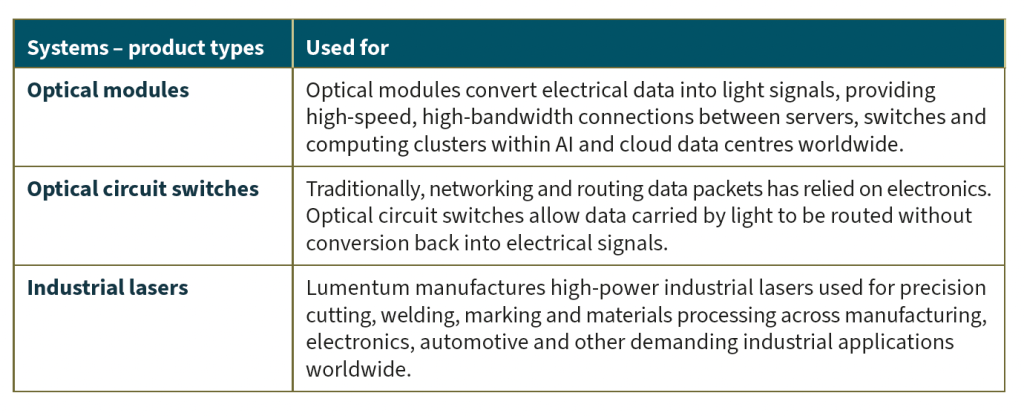
Optical modules – also known as optical transceivers, cloud transceivers or optical pluggables – are of particular interest here. They plug into network equipment, convert electrical data into light, send it through fibre-optic cables and convert incoming light back into electrical signals. They are used in data centres to enable fast, reliable communication between servers, switches and other networking equipment. Unlike copper cables, they can transmit more data over longerdistances while using less power and producing less heat – making them better suited to the speed, scale and energy demands of modern data centres.
Lumentum sells optical components such as EMLs and CW laser chips to manufacturers of optical modules. These include InnoLight, Coherent and Eoptolink. However, as mentioned earlier, in 2023 Lumentum acquired Cloud Light, giving it the capability to produce complete optical transceiver modules incorporating its own laser chips.
EMLs can be used as the light source and modulator within an optical module. However, the 1.6-terabit-per-second Lumentum optical module shown below uses a CW laser rather than an EML. The CW laser generates a continuous optical signal, while modulation is performed separately within the module.
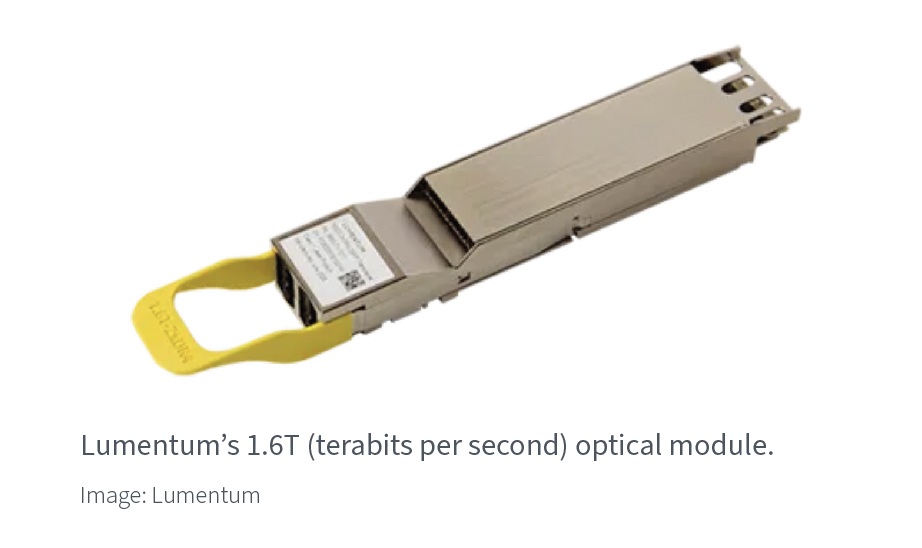
Lumentum’s optical module business appears to be gaining significant commercial traction. As Hurlston commented during the company’s Q4 2026 earnings call: “Notably, in cloud transceivers, we achieved record 800G shipments while initiating production of our next-generation 1.6T modules.”
This is significant, as it indicates that Lumentum is simultaneously benefiting from strong shipments of the current 800G generation while beginning to ramp the faster and more advanced 1.6T modules. Management reinforced this message in the company’s Q4 2026 results, describing the cloud module business and the adoption of 1.6T as important growth drivers that were “beginning to layer in”.
The outlook for optical modules appears bright, with management further stating during the Q4 2026 earnings call: “Our visibility into future cloud transceiver demand is clearer than ever. In fact, we expect the 1.6T transceiver uptake to intensify, starting in fiscal Q1, and sustain through calendar 2027. This momentum is anchored by our lead Tier 1 hyperscaler customers, whose strong roll-outs of custom AI clusters are driving a rapid transition from 800G to 1.6T technology.”
Together, these comments suggest that the Cloud Light acquisition has given Lumentum more than simply an additional product line: it has also enabled the company to participate directly in the rapidly growing market for complete AI data centre optical transceivers while at the same time supplying many of the laser components used within those modules. In our view, this is a powerful strategic position to be in.
Conclusion
Lumentum sits at the centre of a structural shift from copper to light as AI infrastructure demands faster, more efficient connections. Its position across laser chips, optical modules and switching systems gives it exposure to several layers of this transition, while vertical integration may deepen its strategic value to customers. We believe the opportunity is substantial, but realising it will depend on the company’s ability to expand capacity, maintain product quality and convert strong demand into reliable, profitable supply.
As optical links become more deeply embedded within data centres and telecommunications networks, reliability will become increasingly important. Component failures can disrupt costly, mission-critical infrastructure, underlining the competitive advantages of proven quality, manufacturing consistency and dependable supply. Lumentum’s reputation and longstanding customer relationships could therefore become as valuable as its technological capabilities.
Disclaimer:
At the date of this Manager Commentary, the Atlas Global Equity Income Fund owns shares in Lumentum. The fund may exit this position without public notification.
This article is not to be taken as investment advice.
Michael Foster, Fund Manager and Roger Breuer, Analyst – Atlas Global Equity Income
October 2026

………………………
| AUTHORISED AND REGULATED BY THE FINANCIAL CONDUCT AUTHORITY |
| MEMBER OF THE LONDON STOCK EXCHANGE |
| NOT FOR DISTRIBUTION IN THE U.S.A. |
This factsheet has been issued by Fiske plc on the basis of publicly available information, internally developed data and other sources believed to be reliable and accurate. No representations or warranty, expressed or implied, is made nor responsibility of any kind is accepted by Fiske plc, its directors or employees either as to the accuracy or completeness of any information stated in this factsheet. Any opinions expressed (including estimates and forecasts) may be subject to change without notice. This document is not intended as an offer to buy or sell the fund nor as a personal recommendation. Fiske plc, or any of its connected or affiliated companies or their employees, may have a position or holding or other material interest in the fund concerned or in a related investment, or may have provided within the previous twelve months, significant advice or investment services in relation to the investment concerned or a related investment.
Investors must be aware of the risks associated with investment in this fund. Full details of the Atlas Global Equity Income Fund, including risk warnings, are published in the Prospectus and Key Investor Information Document (KIID). Please see www.fiskeplc.com for further information. The fund may not be suitable for all investors and if you are in any doubt whether the fund is suitable for you, advice should be sought from a suitably qualified professional advisor. The value of the fund and the income derived from it can go down as well as up. Investors may not get back their initial investment. Past performance is not necessarily a guide to future performance. Estimates of future performance are based on assumptions that may not be realised. Securities denominated in foreign currencies may see their value fall as a result of exchange rate movements. Any comments contained in this factsheet are intended only for the use of the individual or entity to which it is addressed and may contain information which is confidential and may also be legally privileged. If you have received this document in error, please telephone the Compliance Department on +44 (0)20 7448 4700. Fiske plc FCA Register No: 124279